What I Learned from 3 Productivity Books
I don’t know about you, but I love a good productivity book. Even a mediocre productivity book. I have read so many, and today I’ll highlight what I learned from three of them. Let’s go!
Atomic Habits by James Clear
By now, I think everyone has heard of this book about developing habits to accomplish your goals. Habits are, simply, reliable solutions to recurring problems in our environment. The purpose of habits is to solve the problems of life with as little energy as possible. This book is packed full of wisdom and practical information, but here are my top takeaways:
Trajectory is greater than current results. Habits are the compound interest of self-improvement. Getting a little closer to your goal every day will yield greater progress than a huge jump followed by nothing.
Goals are about the results you want to achieve, systems are about the processes that lead you to those results. So for better results focus on the systems.
Clear points that we often think we lack motivation but what we actually lack is clarity. When I feel like I can’t get anything done, I need to step back and create clarity regarding what I’m trying to do and why.
The four laws of behavior change make better habits: Make it Obvious. Make it Attractive. Make it Easy. Make it Satisfying.
The 12-Week Year by Brian P. Moran and Michael Lennington
The vibe of this book is kind of, “Here’s how you can live up to your full potential in every way!” It was a little too focused on Greatness for me. Of course, I do want to be great at both life and work, but greatness isn’t my main goal. My priorities are more focused around living a good and whole life, but there were a few things in the book that stuck with me.
Redefining your timeline can encourage productivity.
The farther out you are planning, the less predictability you have to work with. Long-term plans are stacked on so many assumptions about the future that it’s difficult to determine how to turn those plans into daily actions.
When we set an annual goal, that creates a perspective that you have all the time in the world to accomplish it, which can make it tough to make small, incremental progress toward it.
The 12-Week Year is all about breaking down annual goals into 12-week increments to help you keep momentum. I’m not really into Goals and Greatness, but I am a huge fan of planning in seasons.
Productive days
The authors say a lack of productivity is not from a lack of time but from how you allocate the time you have. No one wants to hear that, but it’s usually true.
The 12-week Year say the key to a productive week is time blocking, specifically:
Strategic blocks - 3-hour blocks of uninterrupted time scheduled into each week. No emails, no phone calls, no meetings. This is time to work on strategic and money-making activities and recommend at least one a week.
Buffer blocks - this is grouping together activities that tend to be unproductive but can make you feel busy. A 30-minute buffer block once or twice a day to answer emails and voicemails, make phone calls and work on administrative tasks can help keep these interruptions at bay during other times of the work day.
Breakout blocks - these are 3-hour blocks spent on an activity other than work but during normal business hours. This is not practical to everyone’s situation, but something we could take away is that productivity isn’t everything and time away from work actually helps your productivity.
Getting Things Done by David Allen
My main takeaway from this book is that you have to get things out of your head to get them done.
Some of the main ideas include:
Your mind is for having ideas, not holding them. Overwhelm comes from not clarifying what your intended outcome is, not deciding what the next action is, and not reminding yourself of your intended outcome and action.
Getting things done requires defining what “done” means and what “doing” looks like. Some to do’s are decisions and some are actions. Clarifying those can help you tackle your to do list.
If an action will take less than 2 minutes, it should be done at the moment it is defined.
You need to transform all the “stuff” you attract and accumulate into a clear inventory of meaningful actions, projects, and usable information.
Want more?
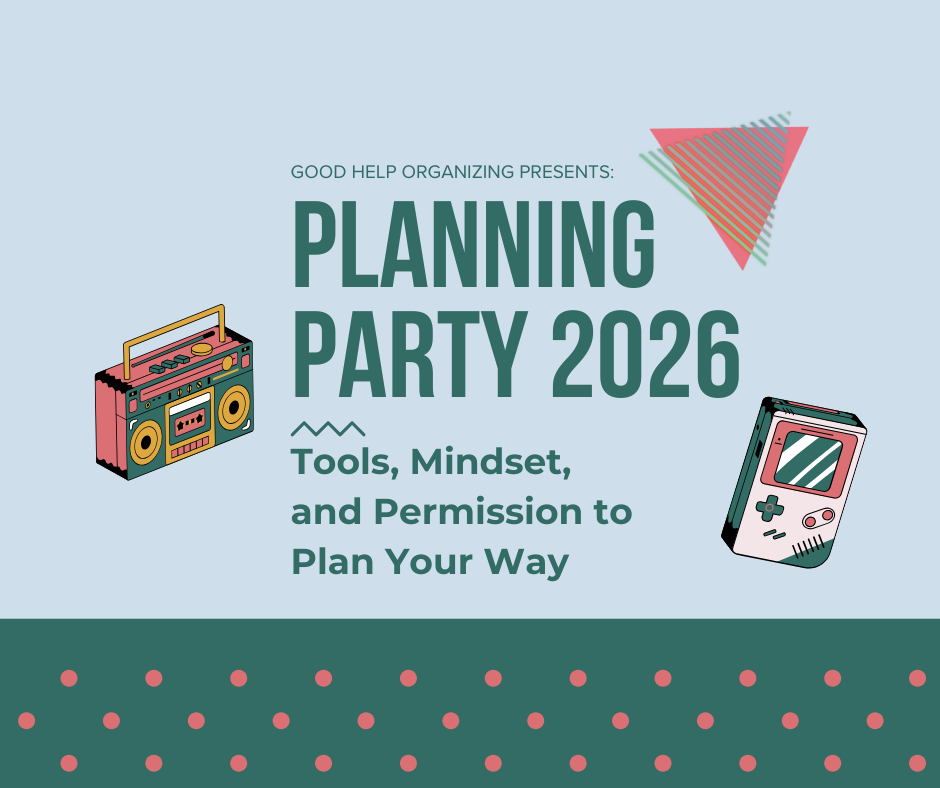
If some of this productivity talk has you thinking about how you plan, what you need to get done, or maybe a pretty 2026 planner, you should consider joining us at the Good Help Organizing Planning Party on January 17, 2026!
We’ll meet at TRAC in Jamestown for a light breakfast, an engaging talk on tools, mindset, and permission, and time to workshop and plan your way!
Click the button for a ticket now!